Cosmic Microwave Background
NASA · Why the night sky is dark · identifies the CMB as relic light from the early universe rather than accumulated starlight.
Raat ka sky dark nahi hona chahiye. Agar Universe infinite hota, hamesha se same rehta, aur har jagah stars equally spread hote, toh tum jis direction mein dekhte, nazar eventually kisi star par rukti.
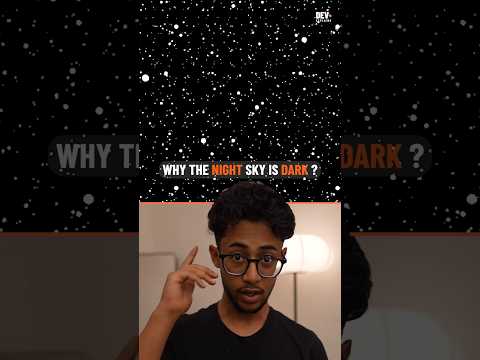
What this reel claims
A static, eternal and uniformly star-filled universe would produce a bright night sky along nearly every line of sight.
In the idealised model, stars become dimmer with distance while the number of stars in successive shells increases by the same geometric factor.
The universe’s finite age and continuing expansion limit and redshift the light that can reach us.
Evidence behind the story
NASA · Why the night sky is dark · identifies the CMB as relic light from the early universe rather than accumulated starlight.
NASA Goddard Space Flight Center · Why the night sky is dark · explains the classical eternal, static and uniformly star-filled universe setup.
NASA Science · Why the night sky is dark · supports the hot-origin interpretation and blackbody spectrum of relic radiation.
NASA Science · Why the night sky is dark · official context for cosmic expansion, distance and age measurements.
NASA Science · Why the night sky is dark · current NASA summary of the universe’s approximate 13.8-billion-year age.
NASA StarChild · Why the night sky is dark · concise explanation of finite light-travel time and cosmological redshift.
What didn’t fit
The cosmic microwave background is relic radiation from the early universe, not ancient starlight stretched into microwaves.
Corrections